
Bobcat
Lynx rufus
Animal Ambassadors
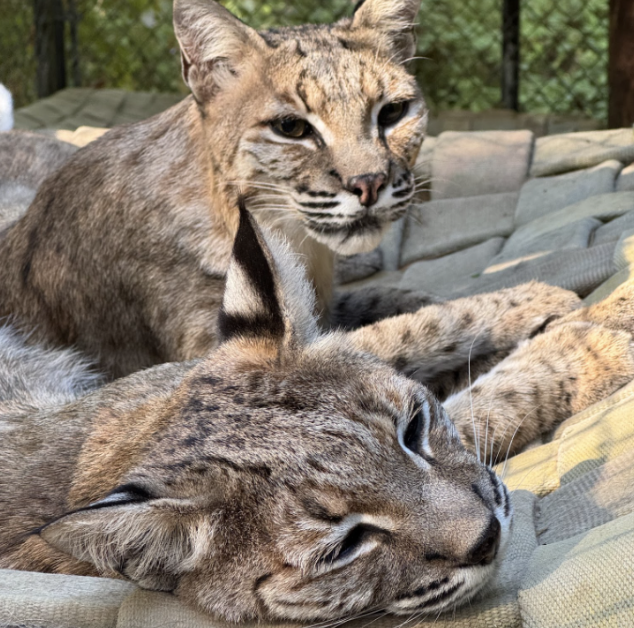
Bobcats, although elusive and rarely seen, are one of the most common wildcats in the United States. They are easily distinguishable by their short, bobbed tails. Additionally, their characteristic tufts of fur at the top of their ears serve as camouflage and help funnel sounds into their ears. You will also notice that they have a number of interesting markings; there are white spots on the backs of their ears, around the mouth and eyes, and under their tails. These are thought to aid in communication! Much like human eyebrows, these markings accentuate facial and ear movements, making it clear to other bobcats how they are feeling. Additionally, baby bobcats can use the bright white spots to help them follow their mother in dim light. These predators are agile tree climbers and are also capable of their size! The ranges of bobcats and Canada lynx overlap in some regions. Although bobcats are smaller, they are much more aggressive and tend to displace lynx when they cross paths. Lynx, however, have the advantage of longer legs and larger feet which are better adapted to hunting in snow. Because of this, Canada lynx tend to live further north than bobcats, reducing conflict between the two species.
Patrick (M) & Mariah (F) Born: August 14, 2013 | Arrived: September 2014
Previously house pets, these bobcat siblings were born in captivity and legally obtained by their previous owner at 8 weeks old. They were heavily socialized and relatively well taken care of. Their owner became ill and was advised by her doctor to rehome them. Unfortunately, exotic pets are much more difficult to rehome than domestic animals as there are few facilities that can appropriately house them. Luckily for Patrick and Mariah, we had space for them here. They are both spayed/neutered and declawed.
Diet:
Rabbits, hares, small rodents, squirrels, birds, white-tailed deer fawns and occasional adults
Rabbits, hares, small rodents, squirrels, birds, white-tailed deer fawns and occasional adults
Range:
U.S., portions of Mexico and Canada
U.S., portions of Mexico and Canada
Lifespan:
5-15 years / 15-30
5-15 years / 15-30
Habitat:
Highly variable, typically rocky, uneven terrain with access to dense brush cover
Highly variable, typically rocky, uneven terrain with access to dense brush cover
Length / Wingspan:
1.5-2 ft
1.5-2 ft
Weight:
9-33 lbs
9-33 lbs