
Black Swan
Cygnus atratus
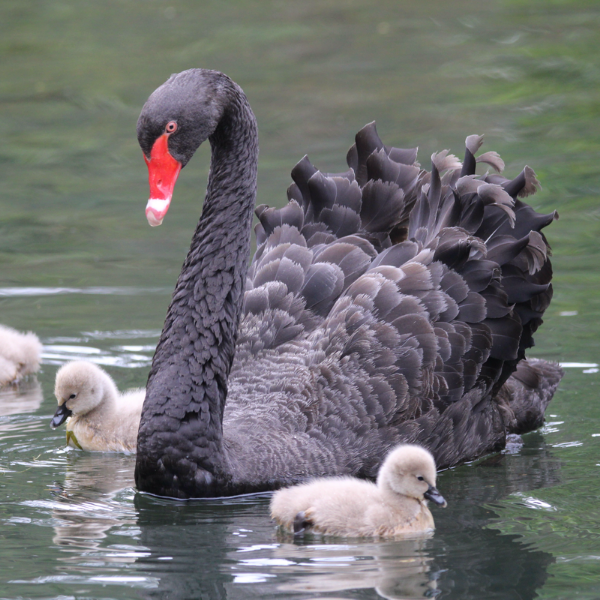
Native to Australia and Tasmania, Black Swans are easily recognizable due to their jet black feathers lined with white and their bright red eyes and bills. Males are called cobs and are larger than females, which are called pens. A group of swans is called a bank or a wedge and baby swans are called cygnets. Black swans are monogamous and usually take a mate for life, but have also been known to sometimes mate in colonies. These swans are territorial (but the least territorial of all swan species) and usually stay in solitary pairs. Their nests can be large mounds up to 3 feet high and they can have anywhere from 4 to 12 eggs in a clutch. The eggs are laid one to two days apart from each other and then the incubation period is 35-48 days after the full clutch is laid, that way the eggs all hatch around the same time. Both the male and female swan incubate the eggs.
Black swans have a very distinct call and use vocalizations and visual displays, such as wing flapping and raising their feathers, to communicate.
Teton (M), Glacier (F), and Zion (M) Hatched: Unknown | Arrived: December 2025
Our wedge of black swans were seized by law enforcement from Wild Coast Game Park Safari in Bandon, OR. The situation that led to their arrival continues to be investigated so we don’t know a lot about the swans’ backgrounds. They are some of our newer residents but definitely catch the eye of guests and staff. They live on Beatrice Pond and are quickly developing unique personalities.
Diet:
Herbivorous. Eats sub-aquatic foliage including leaves, grasses and algae. Occasionally eating insects as well.
Herbivorous. Eats sub-aquatic foliage including leaves, grasses and algae. Occasionally eating insects as well.
Range:
Native to Australia and Tasmania
Native to Australia and Tasmania
Lifespan:
10 - 15 years / Up to 40 years
10 - 15 years / Up to 40 years
Habitat:
Lakes, rivers, swamplands, either fresh, salt or brackish water.
Lakes, rivers, swamplands, either fresh, salt or brackish water.
Length / Wingspan:
5 - 6.5 Feet
5 - 6.5 Feet
Weight:
8 - 20 lbs
8 - 20 lbs